In Part One of our epic look into the equipment of Jimi Hendrix, rock
historian Michael Fairchild dissected the guitar legend's prodigious
use of effects - one pedal at a time - instantly creating an
encyclopedic mass of knowledge on this previously obscure subject. In
this final installment, the author now turns his attention to Hendrix's
guitars and amps - an equally broad subject, but one that surely
warrants another round of microscopic rock scholarship. Now for your
reading pleasure, here is the rest of Hendrix's rig, revealed at last...
Michael
Fairchild is the writer and consultant for the official Hendrix
production company, Are You Experienced?, Ltd., and is the author of
booklet notes for the Hendrix albums ARE You EXPERIENCED?,
AXIS: BOLD AS LOVE, ELECTRIC
LADYLAND, :BLUES, STAGES,
LIFELINES, ISLE OF WIGHT,
WOODSTOCK, and more. Michael is also an
editor and consultant/or the Jimi Hendrix Exhibition: On The
Road Again tour, and the author of the 1988 historical novel
A TOUCH OF HENDRIX and the 1993 short novel, REALLY
A STRANGE TOWN.
-
Pete Prown - Guitar Shop Editor, winter 1995
BURNING OF THE MIDNIGHT AMP
by Michael Fairchild
The Zappa Strat
"I like things from The Mothers," Jimi once said
of Frank Zappa's band. "I like to listen to them. We (the Jimi Hendrix
Experience) had a chance to go into that bag because everybody's mind
is still open. But we decided that we didn't want to get that way
completely towards strict freak-out."
In addition to his connection with Jimi's fuzz face and wah-wah stories,
Frank Zappa is also at the center of a bizarre Hendrix
equipment incident. In 1977, Zappa told Guitar Player
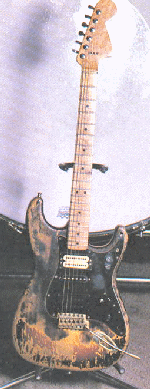
that a Stratocaster he owned was the one Hendrix burned at the Miami
Pop Festival. It was given to me by this guy who used to be his roadie.
I had it hanging on the wall in my basement for years until last year.
Then I gave it to Rex (Bogue) and said, 'Put this sucker back
together,' because it was all tore up, the neck was cracked off, the
body was all fired, and the pickups were blistered and bubbled. That's
the one that's got the Barcus-Berry in the neck. A lot of people
thought I had Hendrix's [burned] guitar from Monterey, but it was from
Miami; the one at Monterey was white, but this one is sunburst."
Zappa Strat
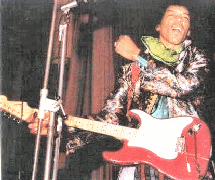
Jimi set fire to his guitar once in London (March
1967) and once at Monterey (June 1967). He also said that one of his
guitars caught fire in Washington, DC (August 1967) - "But that was
accidental." However, both Noel Redding and Mitch Mitchell of the
Experience recall Jimi doing his "lighter fluid routine" only twice:
London's Finsbury Park show, and Monterey. He possibly never did it
again, certainly not at the May
'68 Miami Pop Festival to which Zappa referred. With ABC-TV
filming that Miami show, Linda Eastman taking photos, and with
multi-track tapes being made, everyone would have
known if Jimi burned up a guitar in Miami. The recording of the JHE at
Miami Pop concludes with an emcee interrupting their set right at the
end of a routine version of Purple Haze. "You know, we've
gotta finish!" protests Mitch Mitchell. The emcee butts in: "I would
like to ask everybody to do us a favor. We were supposed to be outta
here five minutes ago, and there are no lights in the parking lot. So
everybody move very slowly, and kind of quick, and we'll do the whole
thing again tomorrow." The fact that it's the end of the show that
night reveals the Jimi did not climax his set fire (nor even a smashed
axe) in Miami. To boot, the next day's show was rained out
"That burning thing," Jimi warned, "We don't do
it very much. Let's see, I've done it a couple of times just for kicks,
'cause the guitar might have been broken anyway. It would've only
lasted about five or six more performances, so I might as well burn it
up, as long as it's still working, so no one will think it's a fake."
Keith Altham was with the JHE in June '67 and
wrote about how they "set out to find an 'indestructible' guitar for
Jimi?We failed to find the model Jimi wanted, but somehow he later
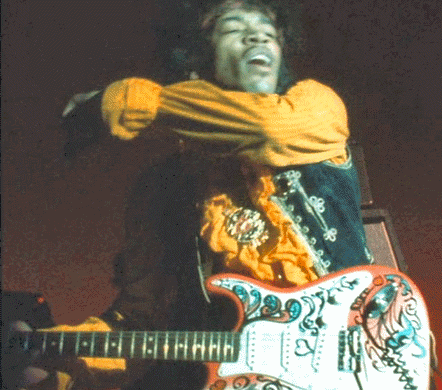
acquired a guitar in Monterey. It was the wrong color but he remedied
that by spraying it white and drawing swirling designs all over it with
a felt pen."
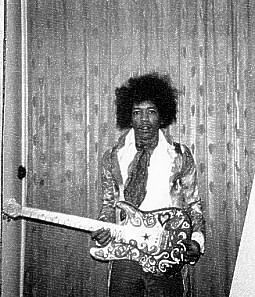
On the guitar Zappa was given there are a few
markings which faintly resemble the patterns Jimi drew on his Monterey
Strat. But Zappa's Strat is sunburst, not white. And the guitar seen in
the video of Monterey appears to have a red body beneath the white
paint. Furthermore, that Strat was also smashed into three pieces, each
part then being tossed into the audience. It's unlikely that all of the
pieces were collected together and rebuilt into the Zappa Strat. But
Jimi's Finsbury Park Strat never got tossed into the crowd after it was
burned, and descriptions of the show give an impression that this
guitar was much less savagely attacked than the Monterey axe.
Jimi kept this guitar and two weeks after the gig
Melody Maker visited him at home and the
interviewer reported how Jimi was "fingering the burnt-out wreck of his
guitar, which burst into flames on the opening night of his tour with
the Walker Brothers." This must be the Stratocaster that Frank Zappa
had. (Some concert-goers report seeing Hendrix burn guitars at other
shows, but I've found that often their memories are faulty. Still, if
any reader has any sightings to report or real evidence, please contact
me about it.)
Axes: Bold As Love
Like the Zappa Strat, each of Jimi's known
guitars tells a historic tale. Several of his most famous guitars are
currently in the collection at Seattle's Jimi Hendrix Museum, where
they'll eventually reside on public display. But the earliest report we
have of a "Hendrix guitar" comes from bluesman Eddie Kirkland, who
remembers meeting a 13-year-old Jimi in 1956. "He was trying to learn
how to play the bass," recalls Kirkland. "He had kin people in Macon,
Georgia, he came down there in the summer and he said, 'Man, I want to
learn; I want to play guitar.' I said, if you're trying to learn how to
play bass, just switch over to guitar. We bought him one of those Sears
Roebuck guitars, one of them kind they made like a bull's head. And he
started playing." Another Macon bluesman, Percy Welch, says, "I
remember, Jimi had a little old green-and-white guitar; I didn't pay no
attention where it came from. He had it before he met me."
Jimi left that axe in Macon and returned home to
Seattle determined to get a guitar. "My first was a Danelectro," he
recalled, "which my dad bought for me. I didn't know that I would have
to put the strings 'round the other way because I was lefthanded, but
it just didn't feel right. I can remember thinking to myself, there's
something wrong here. One night my dad's friend was stoned and he sold
me his guitar for five dollars. I changed the strings 'round, but it
was way out of tune when I'd finished. I didn't know a thing about
tuning, so I went down to the store and ran my fingers across the
strings on a guitar they had there. After that I was able to tune on my
own. Then I went into the Army and I didn't play much guitar because
the only guitars available were right-handed ones.
"I play Fender Stratocaster, with Fender
light-guage strings, using a regular E string for a
B and sometimes a tenor A
string for a little E. To get my kind of sound on
the Stratocaster, I put the strings on slightly higher, so they can
ring longer. The Stratocaster is the best all-around guitar for the
stuff we're doing. You can get the very bright trebles and the deep
bass sound. I tried a Telecaster and it only has two sound: good and
bad, and a very weak tone variation. The Guild guitar is very delicate,
but it has one of the best sounds. I tried one of the new Gibsons, but
I literally couldn't play it at all.
Black Pepper Strat at
Monterey
"I need a Fender. It gets used pretty hard in the
act and they're the only make which will stand up to it. I'm used to
only one kind of guitar, see, the nuts here are steel. We can play, but
since I'm out of tune most of the time, it might slip out of tune a bit
right in the middle of a song and I'll have to start fighting to get it
back in tune. You might not even notice it, but with the way I play the
guitar, it might jump out of tune, and so I have to take away thirty
percent of my playing for three or four seconds to get the guitar back
in tune to keep playing right. It's really a drag when you're tryin' to
play some sounds and the strings slip off the thing up there. We'll
just pretend there ain't no strings, so therefore it'll not slip off."
Black Pepper Strat at
Fillmore West
Whereas May 1967 was largely the month of Jimi's
two red Stratocasters (rosewood neck and maple neck, both last seen in
late May); June was the month of the black Strat with rosewood neck.
The black Strat was debuted during the 4 June gig at the Saville
Theatre in London where the JHE opened their show with Sergeant
Pepper's Lonely Hearts Club Band - as if to celebrate the new
LP release with that same tide by The Beatles. That's why I like to
refer to that guitar as the "Back Pepper Strat." Later that same month
Jimi's Pepper Strat was seen at the Monterey Pop Festival and at the
Fillmore West in San Francisco, before last being photographed during
the free concert in San Francisco's "Golden Gate Park" on June 25.
.
When the JHE were at Monterey, Al Kooper attended
the afternoon rehearsals of the JHE and later in 1968 Jimi asked him to
do some studio work for the Electric Ladyland release. The story goes
that during the session Al admired Jimi's black Strat, and when their
work was done Jimi gave Al the guitar as a gift. It was the only black
Strat with rose-wood neck - the Black Pepper Strat.
Black Pepper Strat at Monterey
Newark, NJ, April 5, 1968
w/white Strat, one of 3 guitars this night.
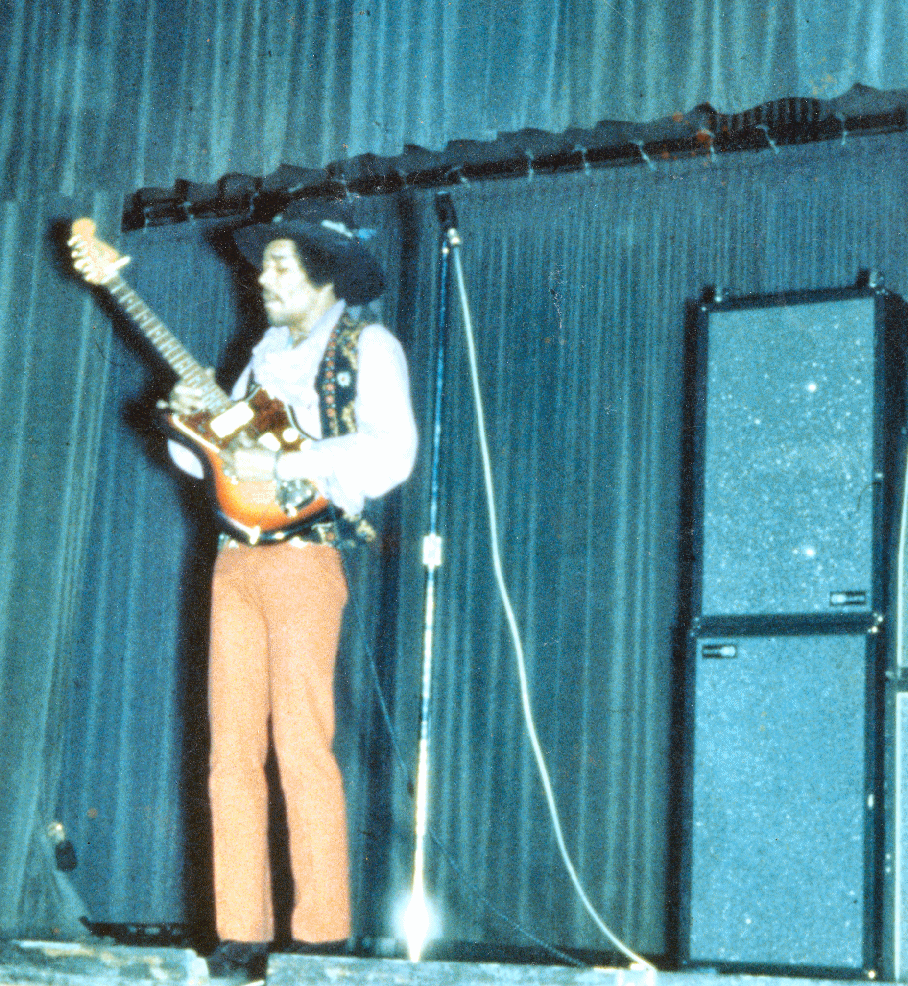
Newark Sunburst Jazzmaster
Sometimes by examining Jimi's equipment we find
answers to non-equipment debates. For example, photos of the guitars
used at a Newark '68 gig prove that one famous story about Hendrix
should be "revised". JHE tour light-show operator Mark Boyle is quoted
in several books and on film describing how Jimi played a dirge in
Newark (April 5, 1968) for Martin Luther King, who had just been
assassinated. "Jimi abandoned completely his normal set," said Boyle,
"he began an improvisation that was simply appallingly beautiful. The
whole audience was weeping...When he finished, there was no applause.
Jimi just laid his guitar down and walked quietly off the stage."
Newark - w/Les Paul "Black
Beauty"
Boyle's memories suggest that Hendrix played just
one long lament to Dr. King, but photos of the show reveal Jimi playing
on three different guitars that night: a white
Strat, a black Les Paul, and a sunburst Jazzmaster. The band played a
lot more than one long jam that night (eye-witnesses, like photographer
Michael Montemurro and his friend, recall a one-hour set and Jimi
ending with theatrics). In fact, Newark is the only
known gig where Jimi uses three different guitar models in one show.
Just as unusual are the models themselves. The Jazzmaster shows up only
at a couple of other dates, while Jimi's black Les Paul period seems to
have been confined to April and May '68 during the peak period of
recording sessions for his Electric Ladyland
album.
Newark
The Black Beauty was used for blues and its
early-April debut waved a black flag of mourning in the wake of Dr.
King's death. There exists great 8mm color film footage of Jimi wailing
blues on his Gibson "Black Beauty" Les Paul custom axe at a May '68
Zurich gig (see below). Just a few weeks later came Jimi's mid-June
jams with Jeff Beck (June 13-16, 1968), featuring a mysterious "Blonde
Beauty" Les Paul. Hendrix was photographed playing this axe at a Scene
Club jam with Beck, and also in the Record Plant on June 14 during
sessions for South Saturn Delta. The blonde Les
Paul may have been one of Beck's guitars that he temporarily loaned to
Jimi.
Video
of Jimi Playing Gibson Black Beauty
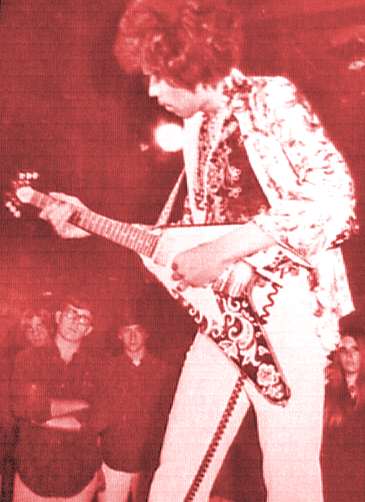
But the standard "alternate" guitar for Hendrix
throughout 1967 and 1968 was his painted Gibson Flying V. "I've got
about 8 guitars," he revealed in '67, "but the two I use are a Fender
Stratocaster and a Gibson Flying Angel, which is shaped like a letter
A. What's wrong, haven't you seen a guitar like this before? It's
extremely rare in Britain, the only other one I know about is owned by
Dave Davies of the Kinks."
Ann Arbor, Aug. 15, 1967
Jimi's painted V debuts in photos from the August
15, 1967, show in Ann Arbor. Two days later a spectacular 35mm color
film was made of Hendrix playing his new V at the Valentineo mansion in
L.A. There are many concert recordings of Jimi playing this axe;
usually he used it for blues. Then in January '69 he gave it to Mick
Cox (guitarist for Eire Apparent), who sold it to Mick Box of Uriah
Heep. By late '68 Jimi was replacing his V with a white Gibson SG. His
SG period ended in autumn '69. In 1970, he began using another standard
black Flying V. This guitar is featured prominently in the film Jimi
Hendrix At The Isle of Wight (BMG 1990) - but the most
sublime of all black V scenes is the transcendent unreleased Maui
footage of Dolly Dagger and Villanova
Junction (July 30,1970).
But back in late '68, Jimi also broke a major
Strat habit. He switched from using rosewood necks to using maple
necks. Until this time, all known Hendrix guitars had been with
rosewood necks except for a guitar Jimi used for his Europe '67 Are
You Experienced? tour. Are You Experienced?
was released on May 12 and three days later Jimi turned up in Berlin
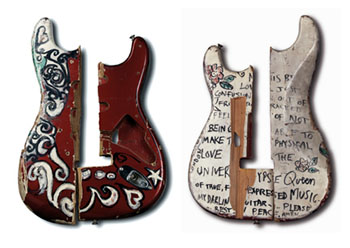
using a cherry-red Strat
with a vanilla maple neck. The most delicious Hendrix color
home movies ever seen show Jimi molesting this instrument at his
first-ever Swedish gig (Gothenburg, May 19, 1967). Jimi finished out
the tour with that guitar and it is even seen on Swedish TV video
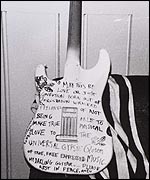
tapes. But then it's gone, never to show up in photos again (it's
likely he painted swirling designs on this Strat at the end of the
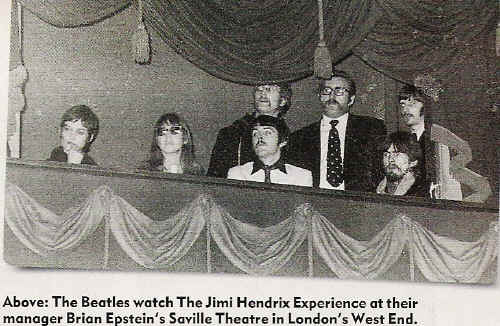
tour and used it to smash the guitar onstage at the June 4, 1967
Saville Theatre concert in London, when the four Beatles came to see
him a few days after their landmark Sgt. Pepper
album came out).
The Red Strat's Last
Stand? June 4, 1967
Painted for the "Beatles"
Smash-up
Occasion
Sacrifice to "The
Universal
Gypsie Queen"
Beatles Stare in Amazement:
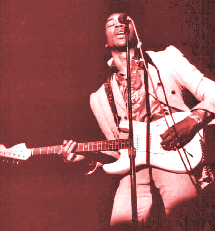
Central Park - July 5, 1967
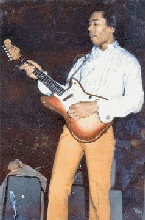
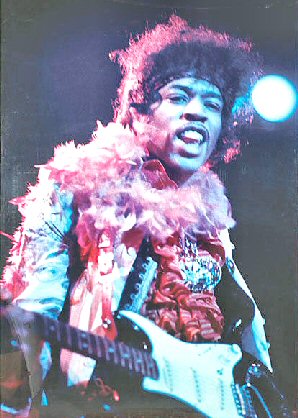
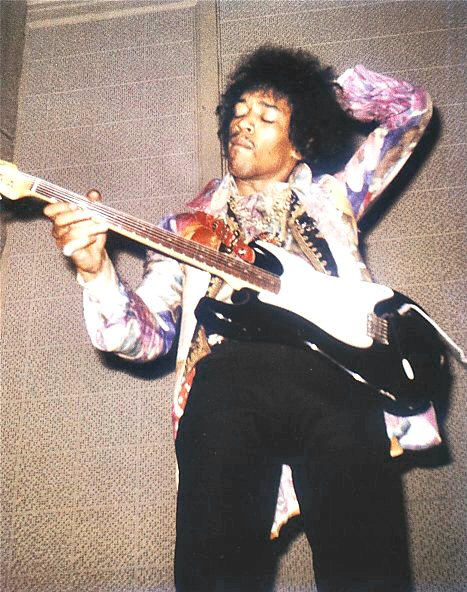
Photographs of Jimi on stage between mid October
1966 and mid February 1967 usually show him with a white Strat with
rosewood neck. Noel Redding noted that Jimi's white guitar was stolen
at the Roundhouse in London on February 22 1967. A sunburst Strat
re-placed the stolen Strat, followed by the red axe period, and then
followed by the Black Pepper period. Then on 6 July 1967, Jimi's
"Central Park" show marked the return of the white Strat. For the next
fifteen months this model is seen in about 90 percent of all Hendrix
stage photographs, until Jimi enters his maple neck period in October
1968. The rarest exception seems to be the Newark (4 April 1968), as
far as I know the only known gig where he used three different guitar
models (Les Paul, Jazzmaster, and Stratocaster).
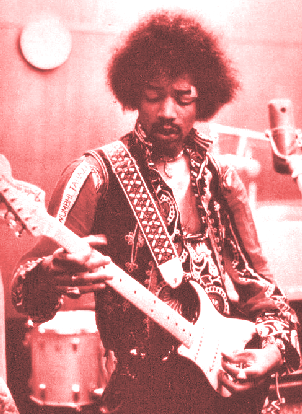
Maple Neck Period - TTG
Studios
Jimi then returned to using rosewood
fingerboards. This reunion lasted until the San Francisco dates in
October '68 at Winterland. The six Winteriand gigs are the last known
rosewood shows. On October 24th Jimi was photographed with a maple-neck
black Strat at TTG Studios in Hollywood. (The woman Jimi was with at
the time of his death confiscated this instrument.) Two days later he
debuted his new "Black Beauty" in Bakersfield for the start of his Electric
Ladyland tour. The following week, from a November 2nd show
in Minneapolis, came the first shots of Jimi's white Strat with a maple
neck (photos of Jimi's gear discussed in this article can be seen in
the book Cherokee Mist published by Harper Collins,
1993). Until his death nearly two years later, Jimi mostly played
Strats with maple necks.
Oct. 1968 at TTG Studios with Sunburst Strat
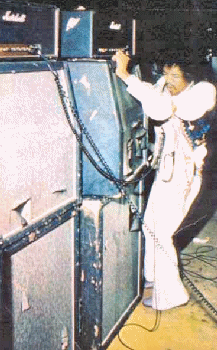
The "Great Wall" of Amps
When the Experience formed in England during
1966, they had at their disposal amplifiers such as the world had never
before seen. One rock tabloid of the day even went so far as to dub
them the "Chinese-nightmare-wall-of-amplifiers."
During the '68 Electric Ladyland
tour roadie Eric Barrett told Hit Parader, "I have
to change speakers after every show. Jimi destroys at least two
whenever he plays. I have 16 spare speakers. When he smashes them, I
put in the spares and send the broken ones back to New York to get
re-coned. Then there's the wah-wah pedal. Most people just touch it
with their foot. Jimi jumps on it with his full weight, so I carry
about three extra wah-wah pedals and ten extra fuzz boxes. He ruins a
lot of tremolo bars too. Very often his guitar has to be stripped right
down and built up again...We used to carry a PA system, but it got to
be too much to handle so we hire PAs for each gig. We use Altec stuff
for the PAs and I carry our own Shure mikes...I use two 200-watt Sunn
amplifiers for Mitch [drummer Mitch Mitchell] and four Sunn speaker
cabinets. For Noel, I use two brand-new Sunn 200-watters and seven Sunn
cabinets. Noel uses Altec 15" inch speakers and they carry very
well...I never have trouble with Noel's equipment, but Mitch breaks a
lot of bass drum pedals. He very seldom breaks the drum skins...Jimi
also burns up a lot of tubes because of the great volume. When a tube
burns out, the volume starts to drop. If he's into something and his
volume drops, he gets extremely angry. 'Fix it!' he yells."
"That's our road manager Eric Barrett
from Scotland. I guess the rest of the show won't sound too good.
You're looking at eight blown amplifiers. I can't fix an amp. I'm not
an amp repairman. It makes me twice as mad when the road manager tries
to tell me that they're overworkin' too much. I guess we have to sit up
here. I don't get much set every fuckin' night because of these damn
amplifiers. We're playing out of the shadows and ashes of the last gig
we did; it's not very healthy. We'll try to pick up the pieces. I think
I've got about four speakers left and about three more valve tubes, and
Mitch Haze on his third pair of arms."
-Jimi, November '68
New Haven, Nov. 17, 1968
Barrett continued, "At a recent concert we played
at Woosley Hall in New Haven (November 17, 1968); the whole place was
wired for DC, and amplifiers are AC! We had to find power a mile away
on the Yale campus and the only wires that long were very thin. We
need- ed two heavy wires that can take twenty amps, but these thin
wires couldn't take the power. As soon as Jimi began to play, all the
fuses blew! We had to set up new equipment and run two heavier wires.
Then, the hall was so huge that there was too much echo and the
microphones couldn't be heard. One night Jimi burned out four
amplifiers. See, his amplifiers are turned full up and pushing what
they're supposed to push, but then the speakers are pushing, plus the
fuzz and the wah-wah. There's ofter more power than the amplifiers car
take. We've ordered some new Marshal equipment for Jimi. I've told them
what goes wrong and they're building new stuff to compensate, plus he
wants a lot more treble."
The JHE completed their American tour on Dec. 1,
1968, and took a break until the new year. Another of Jimi's roadies,
Henry Goldrich, claims that the Marshall factory then customized Jimi's
amps with heavier tubes and re-soldered them to withstand massive
volumn shakedowns. When the Experience regrouped in England, Jimi's
souped-up customized gear was ready to roll for the January 4th kickoff
of the 1969 European tour. But Jimi never got a chance to use any of
it. As one Danish paper reported, "The group's newly purchased,
special-made equipment was stolen...in London where the group's
equipment was locked up in a van. The amplifier equipment and Hendrix's
special gear cannot be replaced...he will have to play on rented
equipment...the audience cannot avoid the technical hazards that have
characterized earlier concerts by Hendrix."
Stock replacement amps were quickly shipped from
the factory. Jimi toured the Continent in January 1969 and was plagued
by the same nagging drag as before:
"I'd like to warn you now, it's going
to be a tiny bit loud for those that forgot to bring ear muffs, because
like these are English amps and we're in Sweden and the electricity
scene is not workin' out with this Australian fuzz tone, and this
American guitar. We're having technical difficulties..." - Jimi
Jan. 9, 1969 Stockholm, Sweden
Jimi Plays Exhausted on 2nd Night of the Tour