|
  |
 |
|
published: May "1991"
Missing
Films of Jimi at Miami Pop Festival |
 What's New & Previews
Jimi's
Prediction —
A Remote View About Jimi Hendrix Timeline Blog Asteroid Impact Evolution Woodstock Blues Jimi Code VS. Da Vinci Code Credit Thefts Missile Agency/Moon Base Charade Seattleland Remote View Mutation Censorship Events Skewed Science Search Engine Rankings Download An Ad AT&T: New Nuremberg Wall(y)flower Syndrome Rochester Media DVD/CD Store More Links...  WHAT
ABC-TV LOST!
by Michael Fairchild
After dinner on Friday
September 18, 1970 I sat on the floor glued to the TV screen, flipping
frantically from one news show to another in hopes of catching a
glimpse of Jimi. The only film clips most people had seen of Hendrix at
that time were scenes from the movies Monterey Pop
and Woodstock.
Suddenly I froze at the sight of Jimi's name on the ABC channel.
Anchorman Frank Reynolds
announced; "The Jimi Hendrix Experience is
over. The acid rock musician died today in a London hospital,
apparently from an overdose of drugs. During his short career,
Hendrix flailed his electric guitar into some of the most
unusual sounds of an unusual music. A report now from
ABC's Gregory Jackson."
A fuzzy industrial wail
inflated the soundtrack as my view
focused on a belt of metallic butterflies encircling Jimi's waist.
He stepped forward seemingly out of the TV screen. The
butterflies sparkled as Jimi clutched the white guitar straddled
before him. In the background Mitch pounded his drums in a
sleeveless white tank-top while Noel bobbed along at far left
stage.
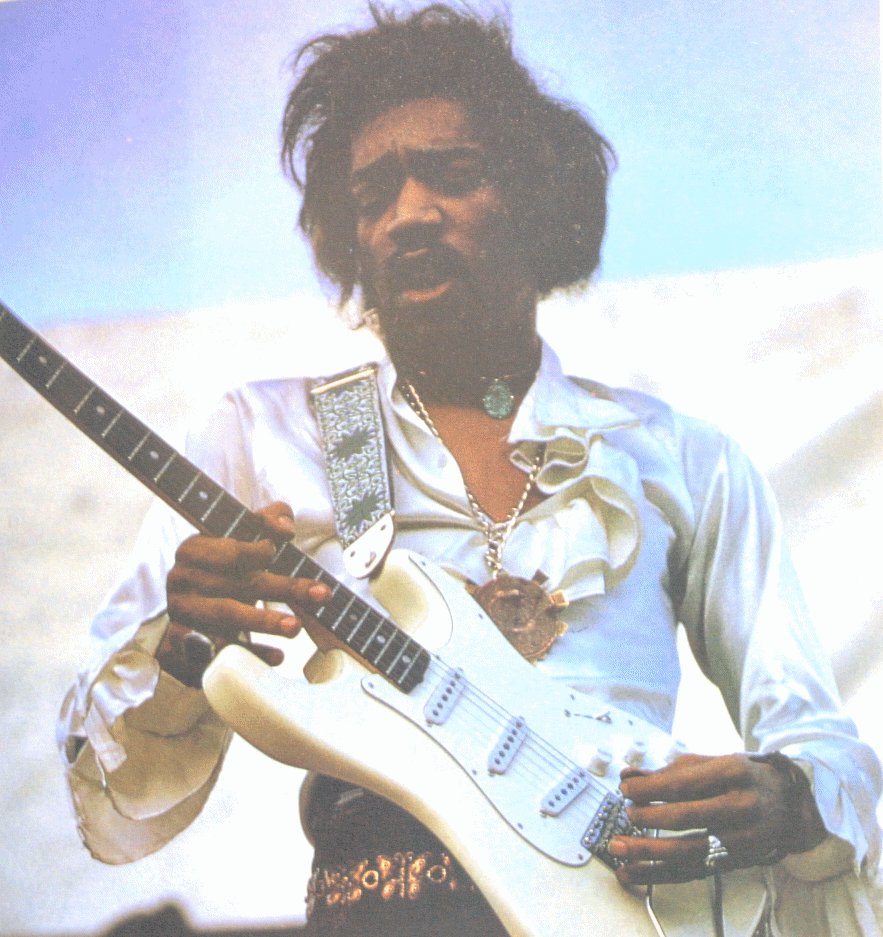 The Experience was flying
through a splashy performance of
Foxy Lady. Our view cut to an angle from
stage rear and I
could see Jimi facing masses of people stretching back into
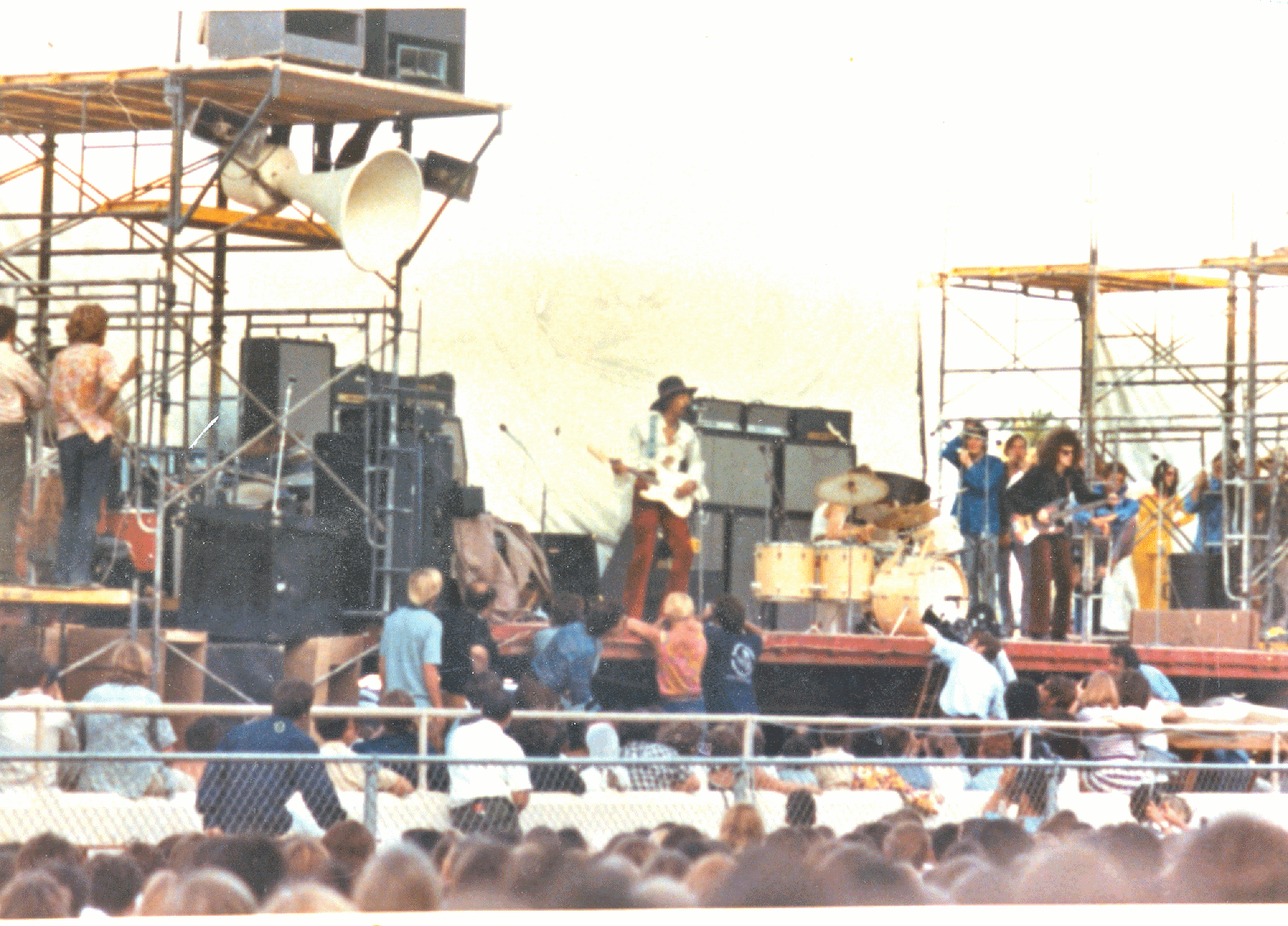
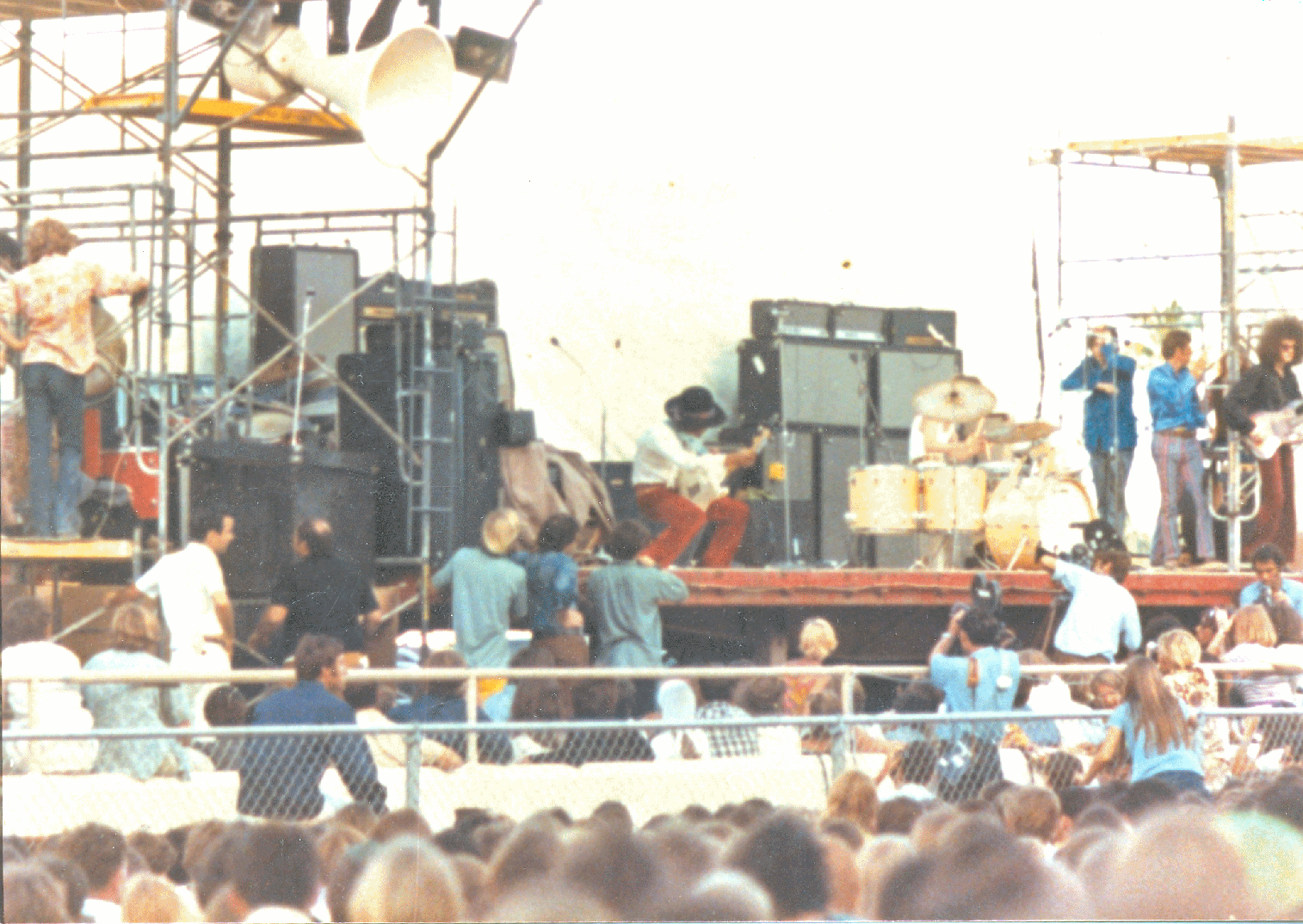
distant grandstands. It was the Miami Pop Festival held in
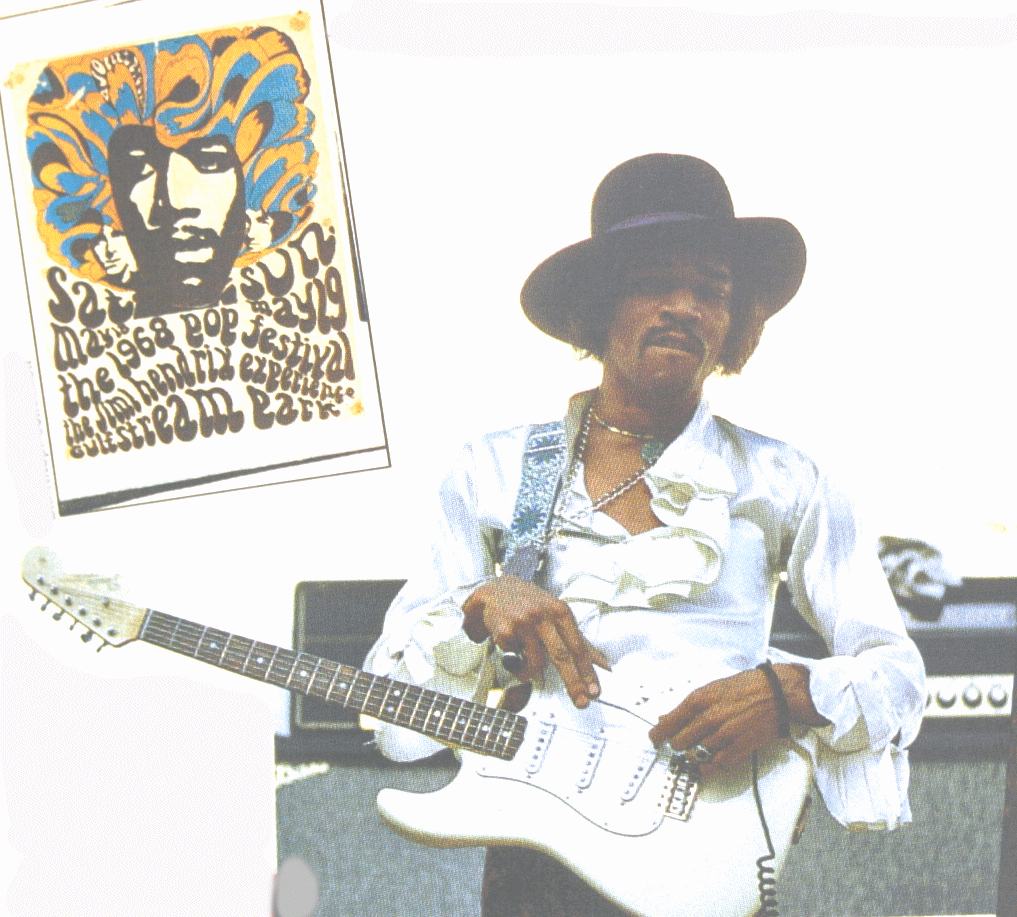
Florida's Gulf Stream Park Race Track on May 18 and 19, 1968. In
addition to hosting the last gig of Jimi's spring 1968
U.S. tour, Miami's "Underground Festival" also featured the
Mothers Of Invention, Blue Cheer, Chuck Berry, John Lee
Hooker, The Blues Image, Tiny Tim, and Arthur Brown.
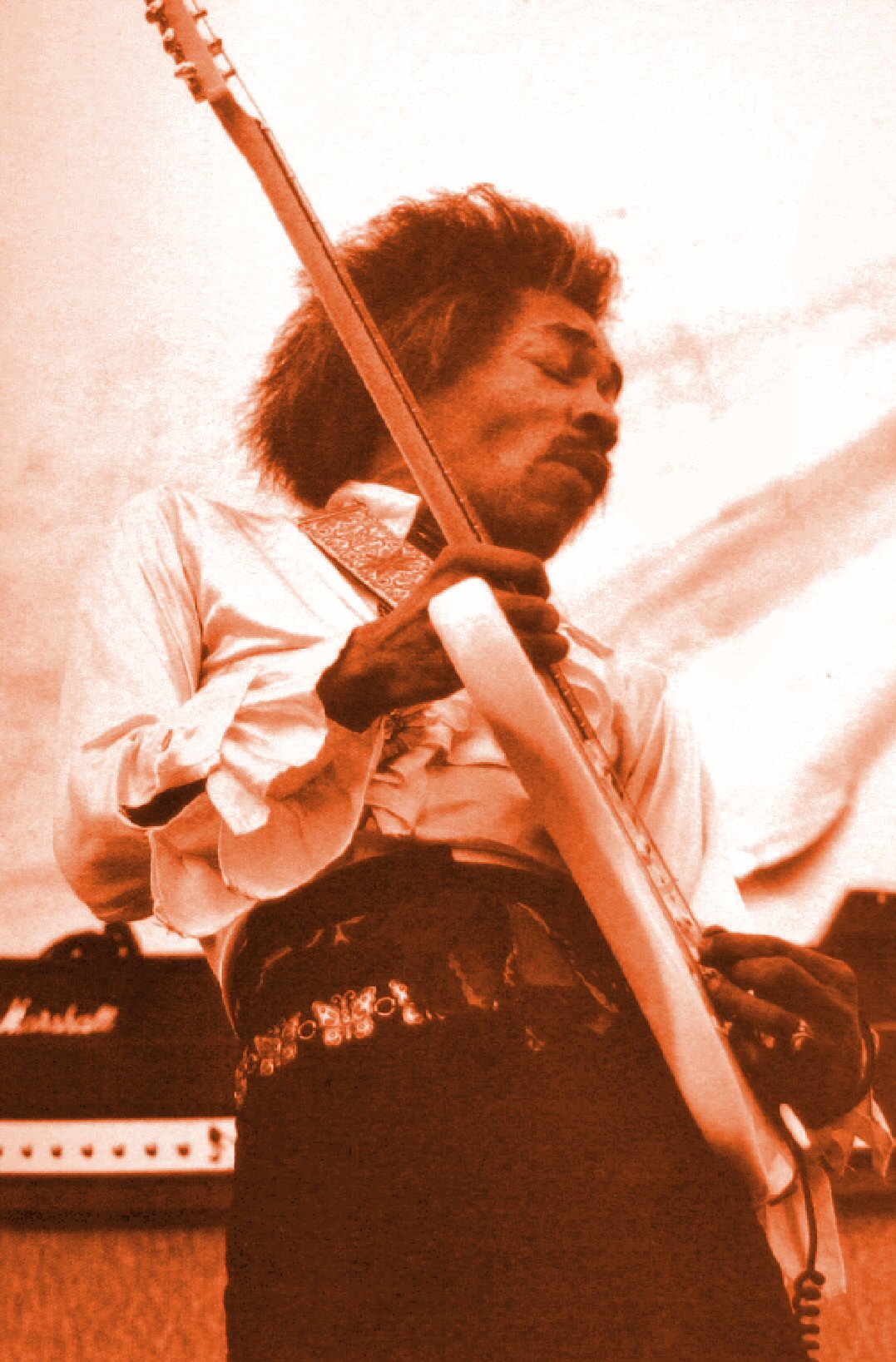
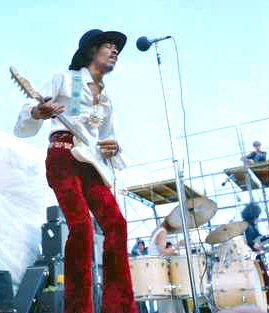 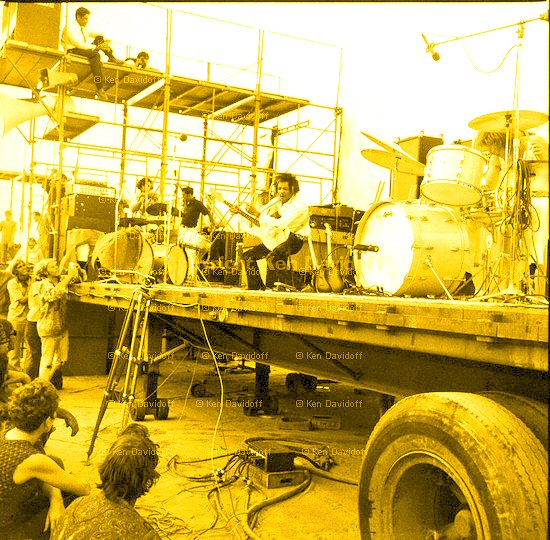 The event was produced by Michael Lang, who would go on to produce the Woodstock Festival in 1969. In his book Woodstock Festival Remembered Lang described some scenes from Miami Pop; "We couldn't figure out how to build stages quickly that would hold everybody surely. We called around and found six flatbed trucks and rolled them onto the track. We set them up two by two so that we could structure the show on three rotating stages. It was going to be a two-day event; two shows a day, afternoon and evening. We rented out booths to sell head-shop gear and assorted psychedelia. We managed to get everything arranged and the crowds came. After the music began we realized somebody had forgotten to pick up Hendrix at the airport. I sent cars out to get him, but Jimi had gotten impatient and decided to rent a helicopter. This turned out to be beautiful. Just as Jimi was due on stage and we were going beserk, this helicopter came hovering over the stage and Jimi comes down a ladder. He played an incredible set. I guess the seed for Woodstock was sown during the Miami Pop Festival...The second day we almost got rained out. We had been in the middle of a drought, so we hadn't bothered to get rain insurance. Sunday morning the city decided to seed the clouds. No one would go on stage because they were afraid of being electrocuted." The ABC-TV footage shows Jimi with freaky blonde patches dyed through his flailing hair. Frills on his white satin shirt sway to the music as his tensed face emotes sounds from his soul. It seems like the stage is showered with an energy field that causes Jimi's hair to stand on end. His exotic "doo" in Miami resembles the top of a nearby palm tree. 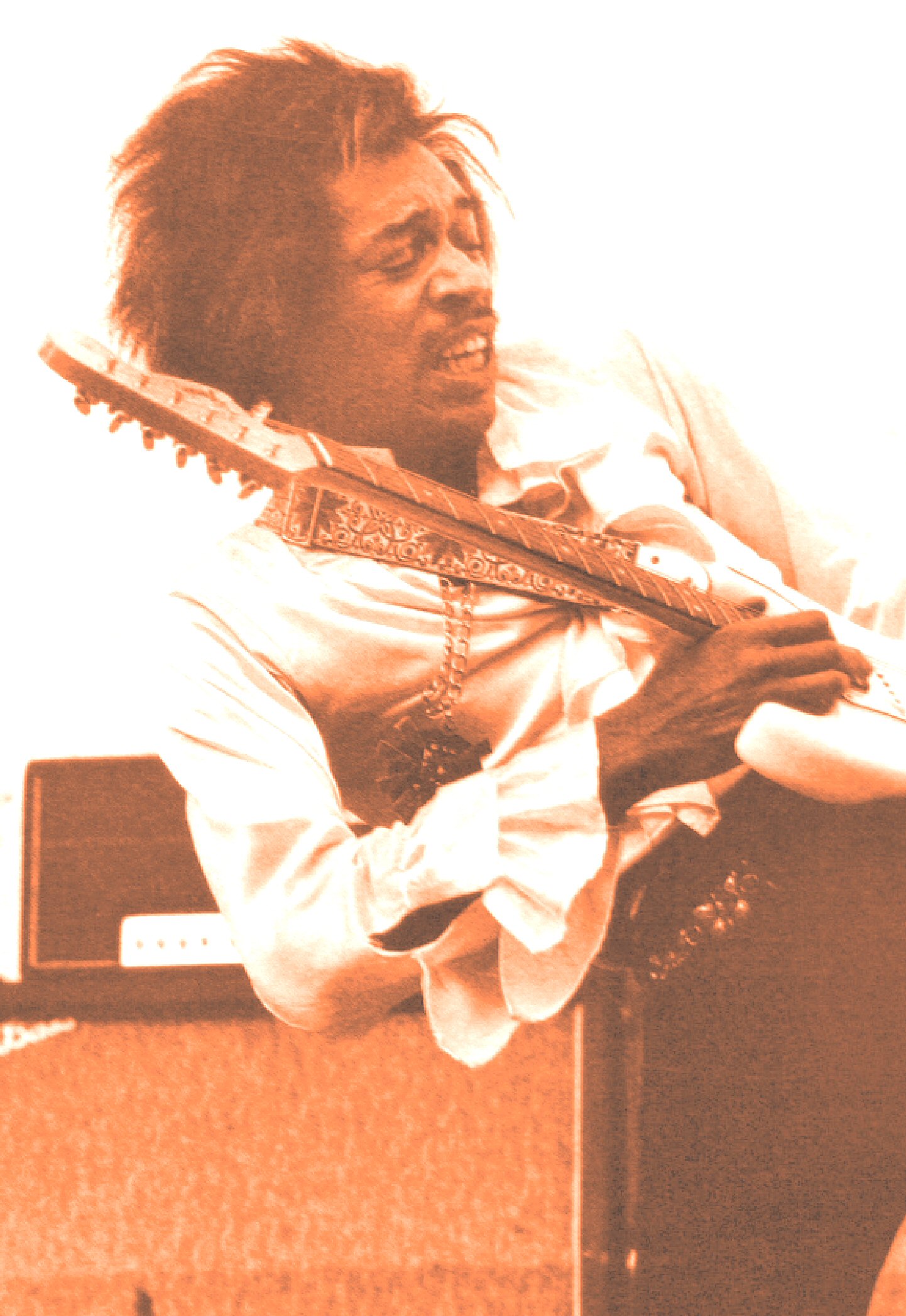 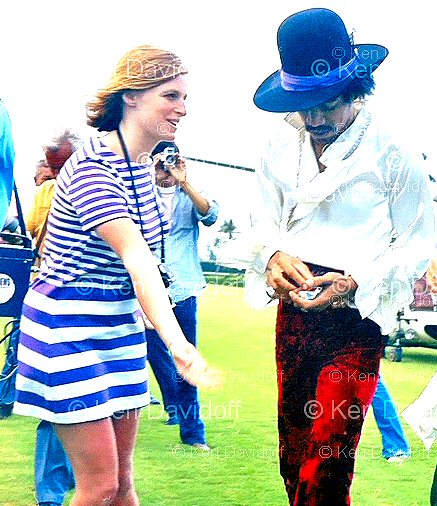
Linda
& Jimi at Miami Pop
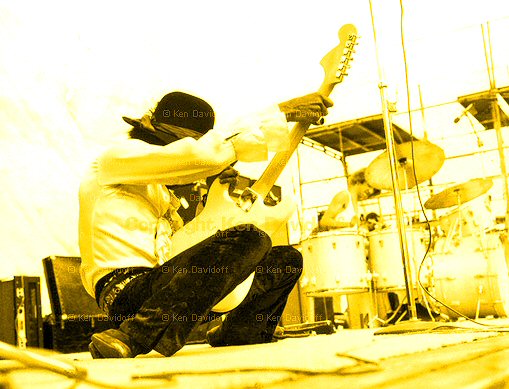
A camera shooting from
stage rear reveals carpeting beneath the band and faces
in the audience staring in disbelief. Appearing full-figure from
behind, Jimi crouches forward to gracefully swipe his elbow
along the length of his instrument's neck. After a final diving
guitar growl, the scene switches to backstage. The view pans
over to Jimi as he takes a bite from a diagonally sliced
sandwich. Gregory Jackson continues, "It may well be
that the story of Jimi Hendrix is a small picture of the overall
explosive power and wealth of rock." An innocent-lamb's
expression from Jimi seems to ask "Who? Me?" as he daintily
positions a pinky to pick at food particles between his teeth.
Next we see him moving towards the stage with his guitar
slung neck down like a bolstered pistol alongside his hip.
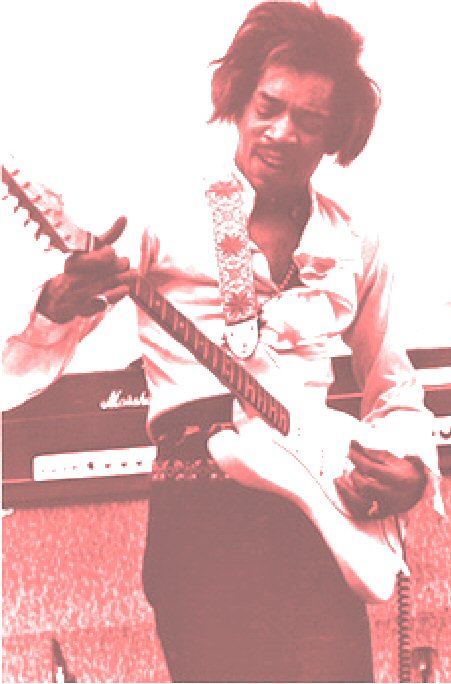
Under a broad rimmed Australian bush hat he looks like a
walking guitar solo! The view cuts to another stage sequence,
this time from the evening set. Perspiration shimmers on
Jimi's skin beneath a dangling gold medallion. He weaves,
heaves, and breathes with the music to grind out a squirrelly
finish for Foxy Lady.
 I adored every frame of
this two-minute ABC-TV
report. I never forgot the scenes during all of the dozen
years it took me to find a video copy and watch it again.
To me, Miami is the most mysterious and fascinating
JHE gig. Of the thousands of Hendrix photos that I've seen,
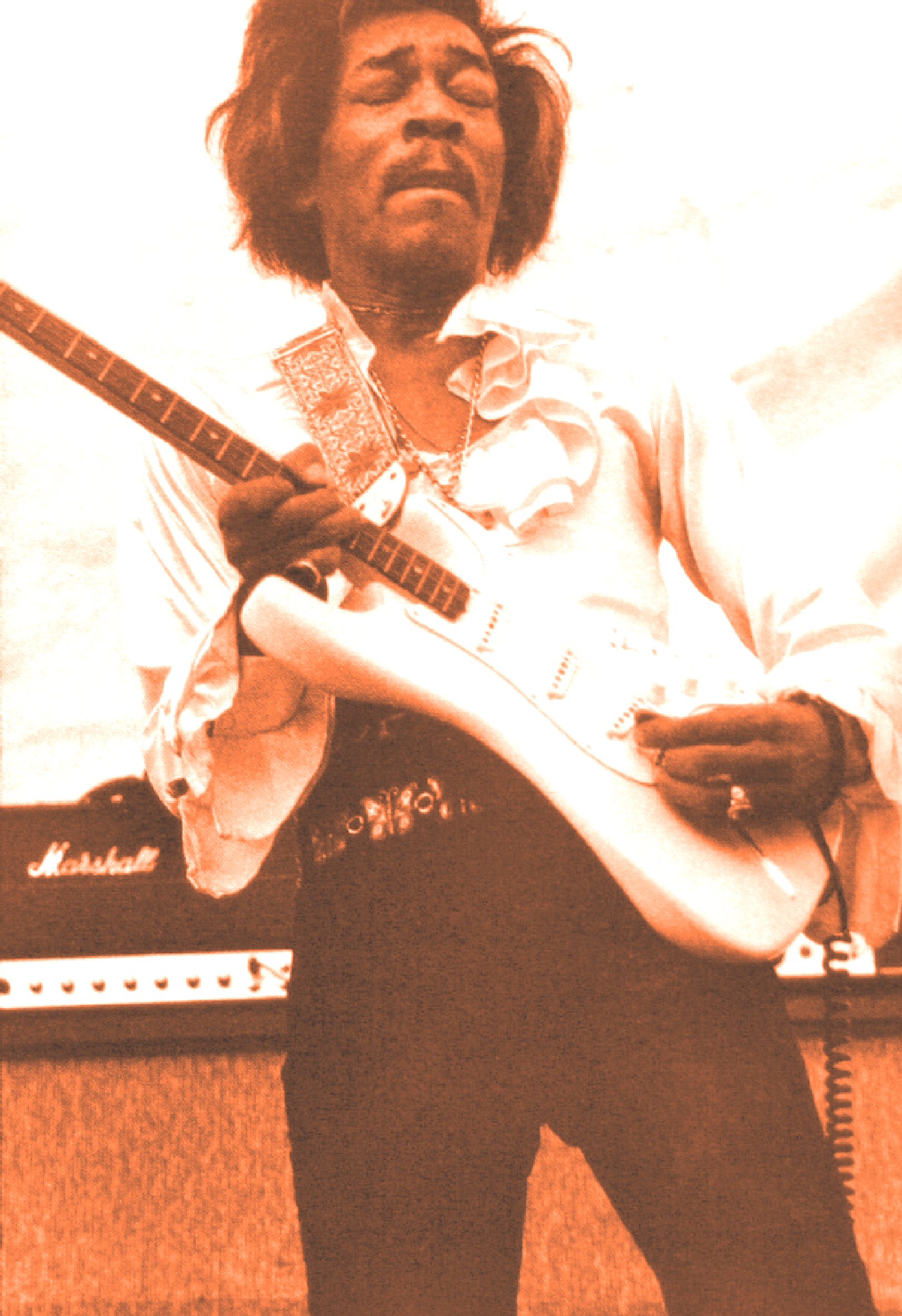
my favorite color picture remains Linda Eastman's "split-
crotch" shot of Jimi with guitar "implant" on stage in Miami.
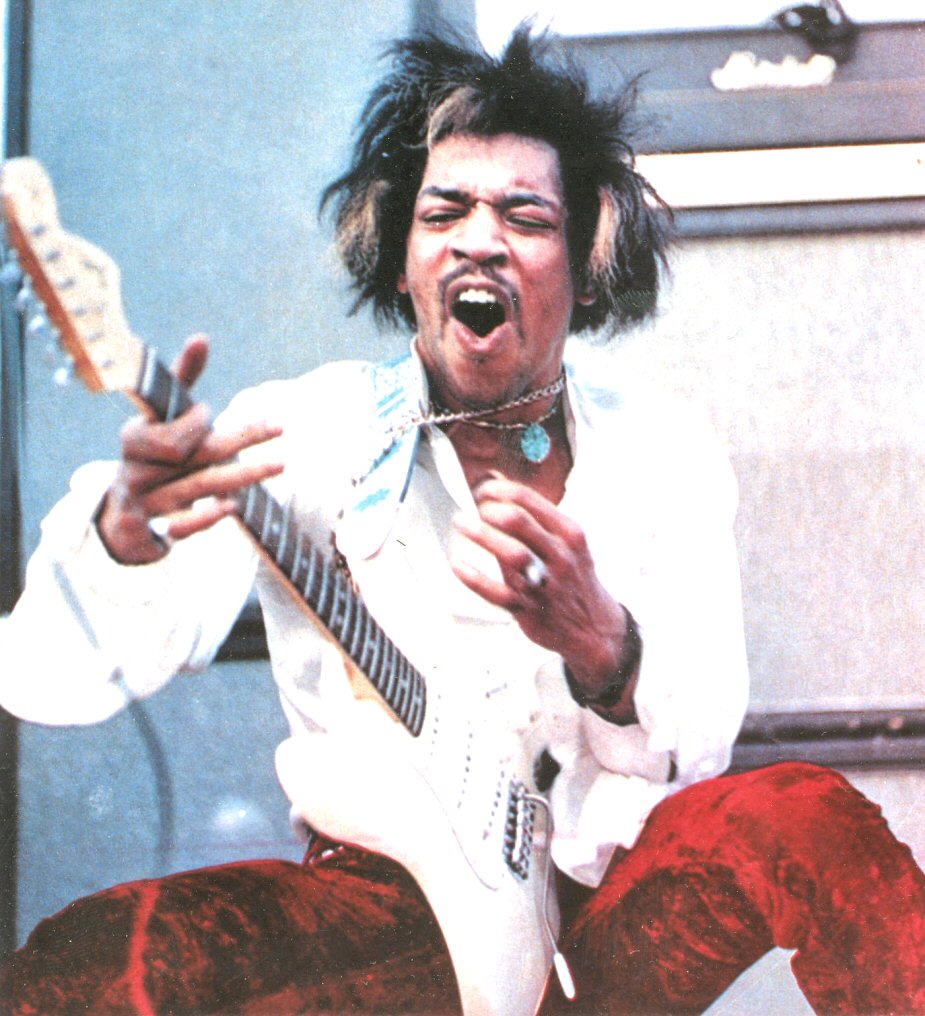
Photo
by Linda Eastman
(McCartney)
"This guy comes along...to give us some extra energy, but it turned out to be some sort of hallucinogen...I looked up and saw the guy who gave us the powder in a lighting tower about twenty-feet above the stage. Suddenly I was on the same level as him, looking down at this empty shell playig the drums. Obviously the powder wasn't what we thought! I looked across and there's Jimi up here with me and we kind of look at each other and nod...it was straight out of Twilight Zone." - Mitch Mitchell
During a deluge the next day Jimi wrote a new song for his next album. "'Rainy Day, Dream Away' was written in Miami, I'll never forget. I was in the back of a car. We were pulling away from Gulfstream Park...Everything was rained out. It was a torrential rain storm, and then he started to write it right there."- Eddie Kramer
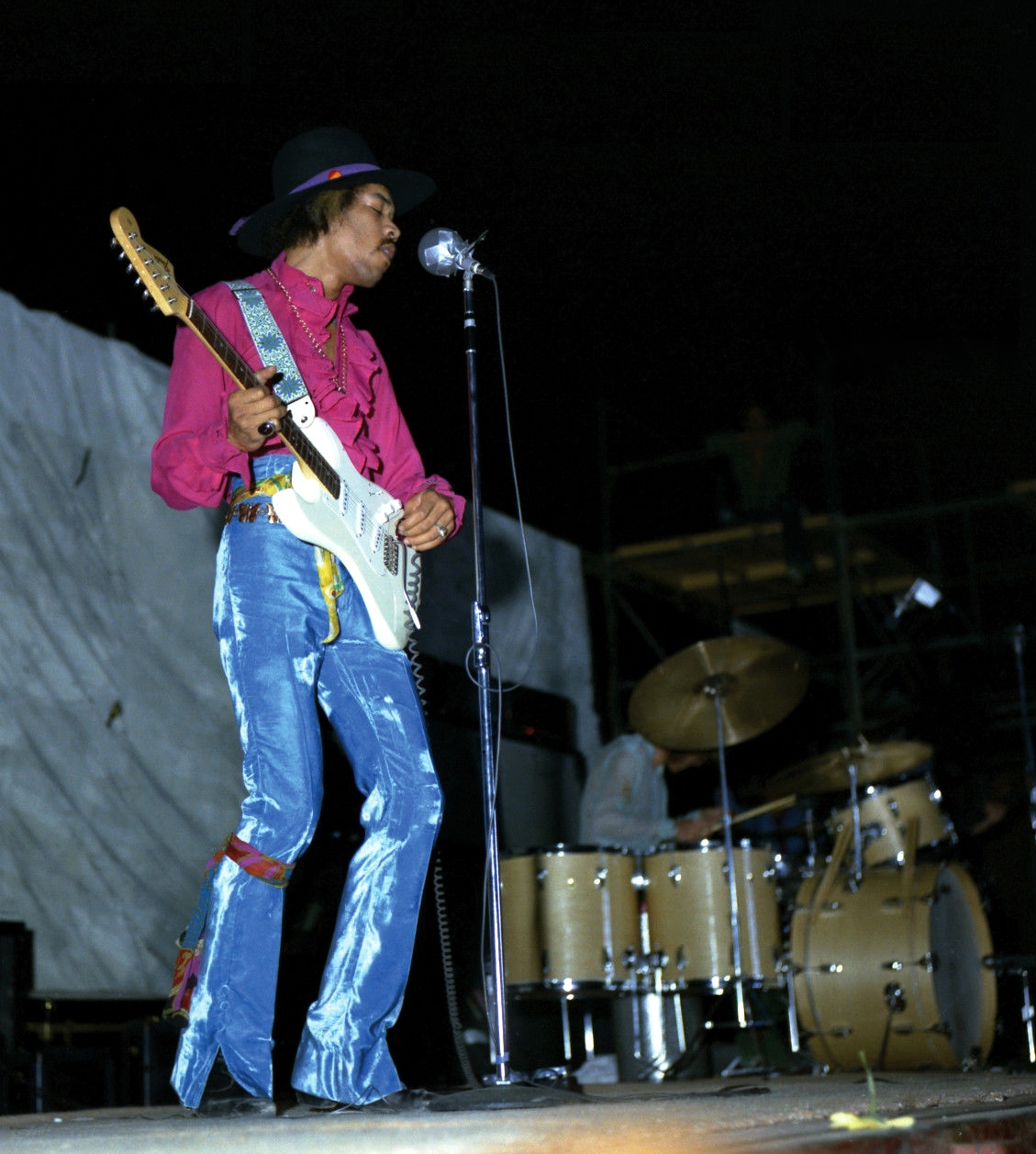
I became more enthused about Miami Pop when a two-track soundboard
recording of the Jimi's second (nighttime) show in Miami surfaced in
1990 (night show pics below).
 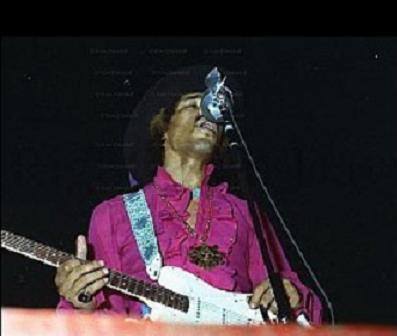 AUDIO:
Purple Haze at Miami Pop (5:01 .mp3 file 4.59 MB) For years I had been told
that Jimi's Miami shows were filmed for a movie to be called Electric
Shades Of Gray. As the story goes, the films were all
destroyed in a fire. I mourned the loss and then forgot about it.
 Then recently I was
researching the archives of ABC-TV and
I found log sheets that are enough to make any Hendrix fan
gag. For sixteen days in May 1968 ABC-TV film crews
followed Jimi around for a story listed as "JIMI HENDRIX
EXPERIENCE". The first log sheet begins with the date "May 3, 1968."
The location is New York. The cameraman's
name is "Roy". On May 3rd Roy shot the following rolls:
"ORIG. COLOR A-600 SOF. MAG.; B-1000 SOF. MAG.,
C-900 FULL COAT". The contents of this first 2,500-feet of
film is listed and described as follows; "Shot of girl sketching
Jimi as he plays guitar and sings, preparation for a recording,
managers and recording engineers listening outside of
recording room; Hendrix performing; Drummer; Back-up
guitarist (bass) for Hendrix playing and reading paper with
friend; Inside recording studio with Eddie Kramer, Interview
with Kramer - He says, "Jimi's music is here to stay. Jimi is
easy to work with, imaginative and quick. Jimi appeals to 12-
16 age teeny-boppers and the 20-up older age group as well."
Kramer discusses Jimi's performing and artistic ability.
Interviews with Michael Jeffery and Chas Chandler - they
discuss Jimi's talent; Hendrix playing guitar and in recording
studio, Drummer and bass. More of Hendrix recording;
Hendrix in sound room with Kramer; Hendrix writing lyrics;
More of Hendrix and back-up musicians playing to the
recording."
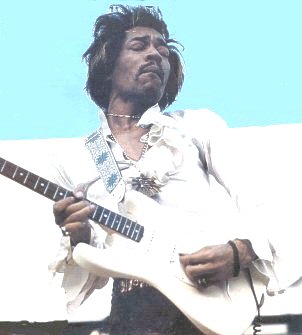 In case anyone is still wondering, the "recording studio" refers to the Record Plant and the "performance" which ABC-TV happened to film there on May 3, 1968 was non other than Jimi recording his classic Voodoo Child (slight return) for the Electric Ladyland album! "With Voodoo Child (slight return) somebody was filming when we started doing that. We did that about three times besause they wanted to film us in the studio, to make us, (pompous voice:) 'Make like you're recording, boys' - one of them scenes, so, 'Ok, let's play this in E there - one a-two and a-three,' and then we went into Voodoo Child." - Jimi For years I've heard people speculate that studio footage of Jimi playing a sunburst Strat, and wearing a tan buckskin jacket with fringe, are scenes from the lost Record Plant films. I disagree. Jimi's hair style gives the period away. That footage comes from TTG Studios in Los Angeles during October 1968. He wears an outfit seen frequently in photos from his November 1968 U.S. tour. The original reels of this October studio footage have recently been found and they contain scenes of Jack Casady jamming with the Experience as well as an unidentified flute player (probably Virgil Gonsales, who had jammed on stage with Jimi at Winterland a couple of weeks earlier). Notice
palm tree resemblance to Jimi's hair,
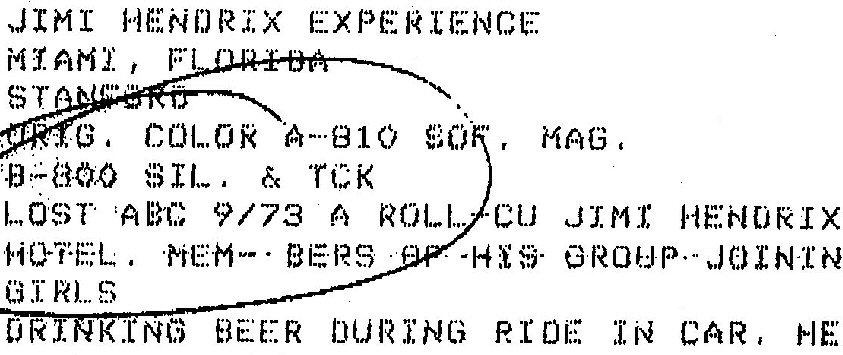
and helicopter top - is this intentional? 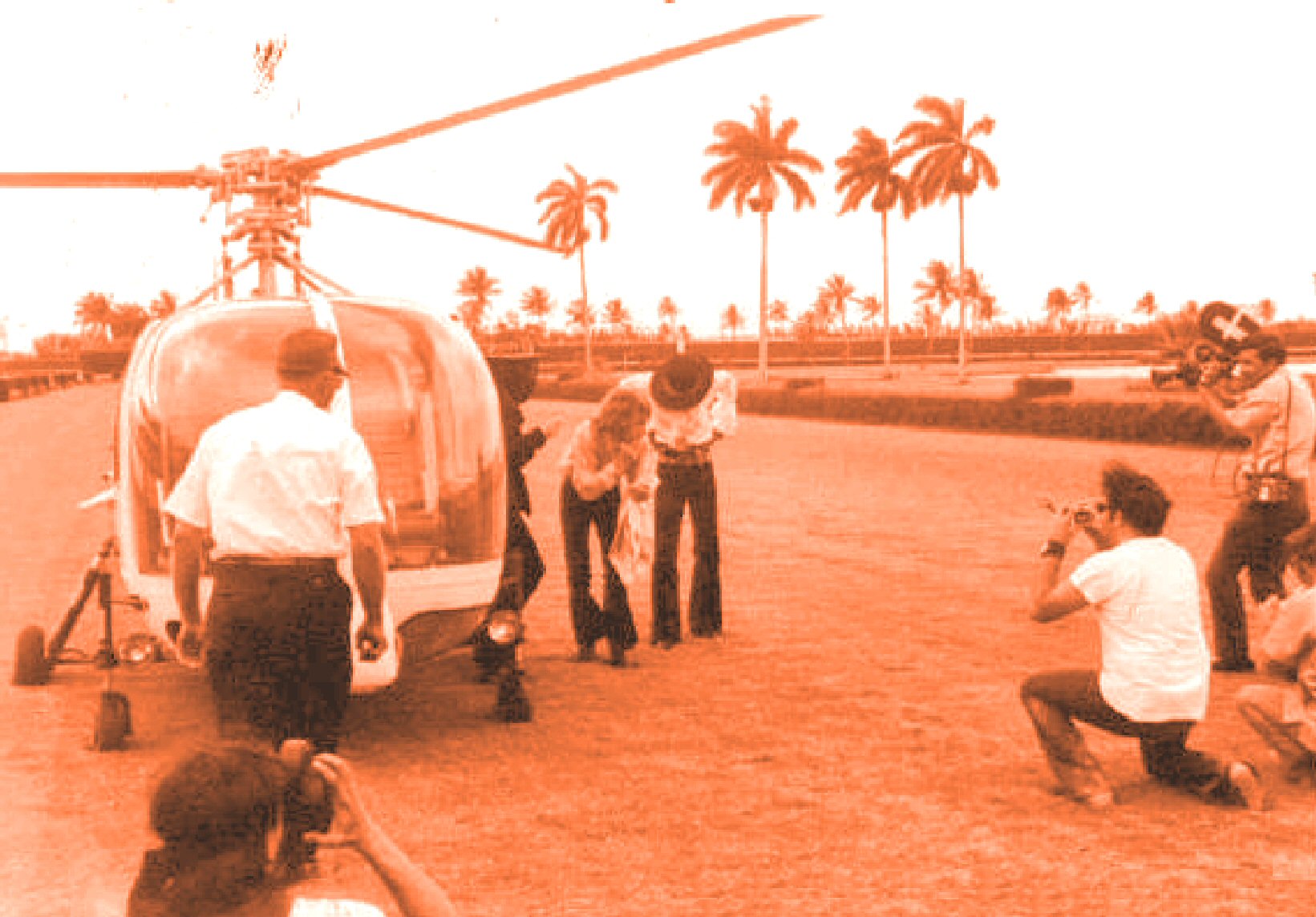 The next ABC log listing is dated May 18, 1968 and the location is Miami, Florida. The cameraman's name is "Stanford". He shot the following rolls: "ORIG. COLOR A- 810 SOF. MAG.; B-800 SIL. & TCK." The contents of this 1,600-feet of film is listed and described as follows: "Jimi Hendrix in outlandish clothes leaving hotel; Members of his group joining him in limousine; Shots of girls drinking beer during the ride in car; Hendrix and his friends getting into the helicopter; Helicopter flight, Shots of the concert advertising poster, Hendrix in a restaurant, surrounded by young people; Girls at a pool; Jimi followed by a crowd of young people; Shots of Jimi in a dressing room with his friends eating; Shots of them arriving at the stadium; Daylight performance; Young people watching; More of Hendrix and his band." 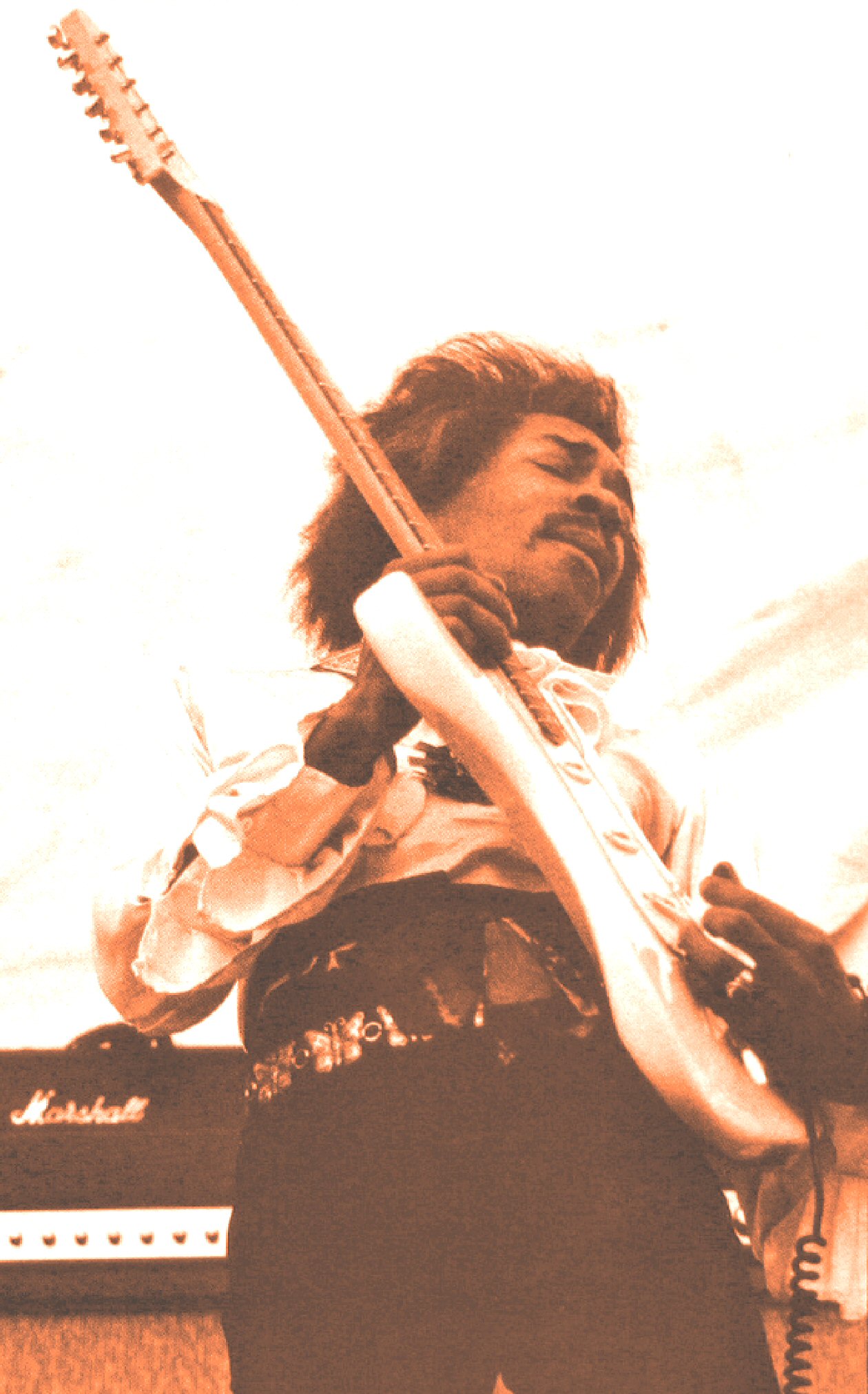 The last ABC log listing
is dated May 19, 1968 and the location
is still Miami. Stanford is the cameraman and he shot the
following roll: "ORIG. COLOR 625 SOF. MAG.". The
content of this footage is an interview with Jimi. Jimi discusses
his work while a friend listens to him. "Hendrix talks about his
group getting started, playing blues, rock and free form
musics. Jimi introduces 'Frank' (Zappa) and a back-up
member of the group. They discuss audience reactions. When
Jimi isn't playing music he writes 'words'. He likes football.
He says he's working on a new type of music which will give pop more
respect. Discusses his moods and ideas."
Also among the ABC
listings is a description for an "EDITED
FILM establishing Jimi Hendrix and his group in a
psychedelic, surrealistic style using beautiful colors,
formations, movement, very brief shots of old and new
buildings are used. The interior of a building, an eerie
staircase, a rag doll, beautiful girls in bikinis, a GO-GO girl and
other objects. All are inter-cut with colors, shapes, suggestions
of movement. All are extremely brief shots. Jimi in a light
show. Lights flashing on stage - audience in foreground. Jimi
singing, playing guitar, shots of his group playing. Fireworks
over the stage."
Several things intrigue me about this description.
It could very
well be that this footage comes from the Foxy Lady
promo
clip, shot at the "Rudolph Valentino" mansion in Los Angeles on August
16,
1967. However, first there is the reference to "Jimi in a light
show. Lights flashing on stage - audience in foreground." I
was told that the ABC crew worked on the JHE story from May 3 through
May 19, 1968. Besides Miami Pop, the only other JHE gig
during this period was at the Fillmore East in New York on
May 10th. Noel Redding stated in Musician (August 1986, p.
76) that "they filmed our May 10 Fillmore East shows"...Elliott Landy's
photos from
this concert reveal an elaborate full-screen light show behind
the band. Surely the ABC film crew was aware of this New
York gig when they turned up to film at the Record Plant a
week earlier. It is likely that the film crew also showed up for
some concert footage at the Fillmore as well. Possibly the
"interior of a building" and "eerie staircase" scenes are
descriptions of shots inside the Fillmore, or more likely these are
scenes that later showed up in Hendrix
promotional videos, this video contains that staircase:
We'd think that whomever has/had this ABC "eerie staircase" footage
would also have the Miami scenes, but then why were the JHE Miami Pop
concert segments never used (except the brief scenes from ABC News TV
coverage of Jimi's death)? Lastly, the ABC log reference to "Fireworks
over the stage"
probably refers to the climax of the Miami Pop Festival when
fireworks formed a large peace symbol over the crowd.
 A friend of mine saw Jimi
in concert three times; once in May
1969, once in September 1970, and at the Miami Pop
Festival. He says forget the rest, Miami was the killer. So
where is the killer footage? And where is the footage of
Voodoo Child (slight return) as it was
being recorded? On
each of the listings from ABC archives are printed the words:
"LOST ABC 9/73". I was told that someone who probably
worked there simply slipped the film reels into a suitcase and
walked off with them. They were all discovered to be missing
in September 1973.
We know that the films
were available on September 18, 1970 when ABC used several brief scenes
for their report of Jimi's death. But we've been deprived of all the
rest at the hands of a villainous art thief.
Did the thief die and leave the unattended films to rot into dust? Are the reels locked away in some forgotten vault or stashed in an attic? Were the films destroyed in a fire, deliberate or accidental? Is some private collector viewing them at this moment? We may never know. Only the as of yet untraceable videotape of Jimi's monumental April 1970 L.A. Forum concert surpasses the missing ABC-TV footage as the Holy Grail of all lost Hendrix memorabilia. 8mm Color Scenes of Jimi at Miami Pop filmed by Andy Seipos
.  .
[NOTE: The above article (not the film clip) was
published in the May 1991 issue of UniVibes
magazine, and it also appears in the book Best of UniVibes
(1992). A research thief called Mr.
Rob(ber)y has published a book in which he credits himself
for the work Michael Fairchild did in 1991 about the lost ABC films of
Jimi at the Miami Pop Festival.
Also, please be aware that for years the owners and staff at the Yahoo search engine have artificially/surgically removed this rockprophecy.com website from all listings under the words "jimi hendrix." Following the example of Paul Allen, the owners of Yahoo are intent on concealing the insights and research of Hendrix scholar Michael Fairchild, out of sheer pathological jealousy. - James Sedgwick]
.
.
|
| © 1991 First Century Press. All Rights Reserved. Contact Us |