 |
  |
 |
|
updated: January 16, "2010"
Past
Impacts / Near Misses / Future Approaches |
|
 What's New
& Previews
Jimi's
Prediction —
A Remote View About Jimi Hendrix Timeline Blog Asteroid Impact Evolution Woodstock Blues Jimi Code VS. Da Vinci Code Credit Thefts Missile Agency/Moon Base Charade Remote View Mutation Seattleland Censorship Events Skewed Science Search Engine Rankings Download An Ad AT&T: New Nuremberg Wall(y)flower Syndrome Rochester Media DVD/CD Store More Links...  Page 2 of 8240-250 Million B.C.E.
The journal Science
[Feb. 23, 2001] reported conclusive evidence that an asteroid smashed
into Earth 250 million years ago and likely launched the age of the
dinosaurs. The impact disaster wiped out 70 percent of land vertebrates
and 90 percent of marine animals. The research performed by NASA, the
National Science Foundation, and three leading universities, revealed a
type of carbon structures called fullerenes
in 251 million year old geological samples taken from Japan and China.
On June 1, 2006 scientists, using satellite data, discovered the 300-mile-wide crater buried more than a mile beneath the East Antarctic Ice Sheet in what's known as the Wilkes Land region of Antarctica. 65 Million B.C.E. In 1979 physicist Luis Alvarez, his son, geologist Walter Alvarez, and nuclear chemists Frank Asaro and Helen V. Michael from the University of California, Berkeley, began to publish their research regarding "Extraterrestrial cause for the Cretaceous-Tertiary extinction." In June 1980 the journal Science published the Alverez team's groundbreaking report titled, Extraterrestrial Cause for the Cretaceous-Tertiary Extinction. The team had discovered unusually high concentrations of iridium, an element that's rare on the Earth but common in meteorites. From the amount and distribution of iridium present in the 65 million year old "iridium layer", the Alvarez team estimated that an asteroid about 5 milies wide (10–14 kilometers) must have collided with the Earth. This iridium layer has been found worldwide at 100 different sites. In 1981, exploring for oil reserves in Yucatan, Mexico, Penfield and Camargo recognized that the gravity and magnetic anomalies centered on the village of Chicxulub, at the tip of the Yucatan peninsula in Mexico, resemble those identified at large impact structures. But it was only in 1991, that Hildebrand et al., proposed that the long sought impact crater lied buried under 1000 m of Cenozoic sediments at the tip fo the Yucatan peninsula. During the following years, the crater origin of the structure was demonstrated by geophysical and lithological studies and its age determined by radiometric dating (Swisher et al. 1992; Sharpton et al. 1993). The northwestern part of the crater lies offshore of the Yucatan peninsula. Onshore the crater rim is marked by a line of cenote (Pope et al, 1996). 35 Million B.C.E. Thirty five million years ago, a 5 km-wide asteroid ploughed into what is now Chesapeake Bay, in the US, leaving an 80 km crater. Undetermined
Date:
Kebria Crater in
Egypt
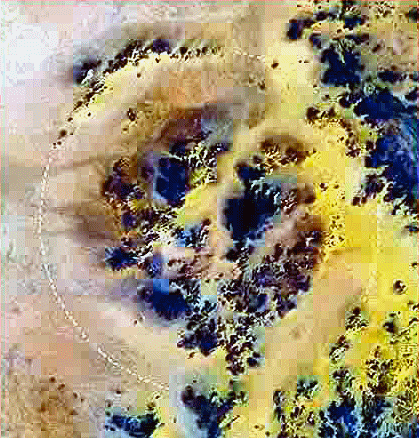 On March 3, "2006" Space.com reports, "Huge Crater Found in Egypt - Scientists have discovered a huge crater in the Saharan desert, the largest one ever found there. The crater is about 19 miles (31 kilometers) wide, more than twice as big as the next largest Saharan crater known. It utterly dwarfs Meteor Crater in Arizona, which is about three-fourths of a mile (1.2 kilometers) in diameter. In fact, the newfound crater, in Egypt, was likely carved by a space rock that was itself roughly 0.75 miles wide in an event that would have been quite a shock, destroying everything for hundreds of miles. The crater was discovered in satellite images by Boston University researchers Farouk El-Baz and Eman Ghoneim. El-Baz named the crater 'Kebira,' which means 'large' in Arabic and also relates to its location on the northern tip of the Gilf Kebir region in southwestern Egypt…The crater has two rings, a common configuration. Over time, it has been eroded by wind and water to make it unrecognizable to the untrained eye. The impact that carved Kebira might have created an extensive field of yellow-green silica fragments, known as desert glass and found on the surface between the giant dunes of the Great Sand Sea in southwestern Egypt." "The
Zodiac Glass gleams through the sky, it could happen soon…If you revert
back in time, there's Egypt. It's very dusty now, but it used to be
green. I had a vision and it told me to go there. I'm always having
visions and I know that it's building up to something really major."
17 Million B.C.E. Two asteroids crash into the Atlantic Ocean 150 km (93 miles) south of the Azores. The larger one left a crater 6 km (3.7 miles) wide, 2 km (1.2 miles) under the ocean surface. The craters were discovered in 2008. Meteor Crater, AZ
 48,000 B.C.E. A meteor about 50 meters (54 yards) across impacts the desert near what is now Flagstaff, Arizona, leaving a crater about 1,200 m (4,000 ft) in diameter, some 170 m deep (570 ft), In June 2007 University of South Carolina News reported: Comet Theory Collides with Clovis Research, May Explain Disappearance of Ancient People: "A theory put forth by a group of 25 geo-scientists suggests that a massive comet exploded over Canada, possibly wiping out both beast and man around 12,900 years ago, and pushing the earth into another ice age. Archaeologists have long known that the great beasts of the age - the wooly mammoth and mastodon - suddenly disappeared around the same time period (12,900 - 12, 800 years ), but little was known about their demise. The notion that a comet collided with Earth and caused these events was farfetched until recently, when the group of scientists began looking for evidence of a comet impact, which they call the Younger - Dryas Event.
 "They turned to University of South Carolina archaeologist Dr. Albert Goodyear and the pristine Clovis site of Topper. In 2005, Arizona geophysicist Dr. Allen West and his team traveled to Topper in hopes of finding concentrations of iridium, an extra-terrestrial element found in comets, in the layer of Clovis-era sediment. 'They found iridium and plenty of it,' said Goodyear. 'The high concentrations were much higher than you would normally see in the background of the earth's crust. That tends to be an indicator of a terrestrial impact from outer space.' The researchers also found high iridium concentrations at six other Clovis sites throughout North America, as well as in and along the rims of the Carolina Bays, the elliptically shaped depressions that are home to an array of flora and fauna along South Carolina's coast. The Younger-Dryas Event suggests that a large comet exploded above Canada, creating a storm of fiery fragments that rained over North America. The fragments could have easily killed the giant mammals of the day, as well as Clovis man.  "'No one has ever had a really good explanation for the disappearance of mammoth and mastodon,' Goodyear said. 'The archaeological community is waking up to the Younger-Dryas Event.' The comet theory dominated the recent annual meetings of the American Geophysical Union held in Mexico. Goodyear's Clovis-Redstone point study and West's research on the comet were featured at the AGU meetings and by the journal, Nature. The comet will be the subject of documentaries featured on the National Geographic Channel and NOVA television late this fall [2007] and in early 2008." 8498 B.C.E. German physicist, Otto Muck, analyzed the elaborate calendar of ancient Mayan Indians and established that its purpose is to commemorate the date and time of impact of an asteroid that crashed into the Atlantic Ocean more than ten thousand years ago. In his book, The Secret of Atlantis, Muck concludes that the impact coincided with a conjunction of the Sun, Moon, and Venus. This triple conjunction enabled a calculation of orbits to find the exact moment of impact: 20:00 hours local time on June 5, 8498 B.C.E. From this cataclysmic moment over 10,500 years ago, marked by a triple conjunction, ancient Mayans counted the days and years of their calendar. Muck concludes that the impact and tidal waves produced the story of Atlantis, as well as the biblical flood of Noah, and the legend of Gilgamesh. Other researchers contend that a comet or asteroid that crashed into the Indian Ocean south of Madagascar 4800 years ago (see below) is a better candidate as the souce of the Noah/Gilgamesh legend, because Hebrew writings, the souce of the Noah story, date back only to the 6th century B.C.E. But then in January 2010 LiveScience.com reported that "scientists have discovered the earliest known Hebrew writing - an inscription dating from the 10th century B.C.E., during the period of King David's reign. The breakthrough could mean that portions of the Bible were written centuries earlier than previously thought…The writing, dug up during [2009] excavations at Khirbet Qeiyafa, near Israel's Elah Valley, indicates that the Kingdom of Israel already existed in the 10th century B.C.E. and that at least some of the biblical texts were written hundreds of years before the dates presented in current research." This scenario supports Muck's assertion that a fully developed Hebrew writing society dating back 12,000 years would likely have recorded a massive tsunami in the region that occurred 10,500 years ago, a tsunami that we know today as "Noah's flood." Until the ancient writings from Khirbet Qeiyafa were unearthed in 2009, it appeared that the story of the Noah/Gilgamesh flood likely resulted from a more recent impact tsunami near Madagascar 4800 years ago… 2800 B.C.E. Microscopic
"Spherule"
Fingerprint of Asteroid-Tsunami  The New York
Times News Service (Nov. 14, 2006) reports, "This tiny
spherule [see right] is a once-vaporized or melted fragment of
microejecta resulting from an extraterrestrial impact into the Indian
Ocean about 4,800 years ago. Some scientists believe the hit, by either
a meteor or asteroid, produced a tsunami at least 600 feet
high…Madagascar provides the smoking gun for geologically
recent impacts…tiny fossils from the ocean floor, sprinkled throughout
[with] splashes of iron, nickel and chrome fused to the fossils. When a
chondritic meteor, the most common kind, vaporizes upon impact in the
ocean, those three metals are formed in the same relative proportions
as seen in the microfossils…[that] melded with the condensing metals as
both were lofted up out of the sea…About 900 miles southeast
from Madagascar, in deep ocean, is the Burckle Crater…cores
from the area contain high levels of nickel and magnetic components
associated with impact ejecta. Holocene Impact Working Group…experts
in geology, geophysics, geomorphology, tsunamis, tree rings, soil
science and archaeology…say that astronomers simply have not
known how or where to look for evidence of [asteorid] impacts.
They say that once they
started looking, the evidence was obvious…
Classic
Chevron Insignias
 "At the southern end of Madagascar lie…enormous wedge-shaped sediment deposits, called chevrons, that are composed of material from the ocean floor…the chevron deposits contain deep ocean microfossils that are fused with a medley of metals typically formed by cosmic impacts. And all of them point in the same direction - toward the middle of the Indian Ocean where a newly discovered crater, 18 miles in diameter, lies 12,500 feet below the surface. Fenambosy
Chevrons in Madagascar

Chevron
points directly at 4800 yrs. old
impact crater at bottom of Indian Ocean "Surveys show that as many as 185 large asteroids or comets have hit the Earth [but] most of the craters are on land. 'No one has spent much time looking for craters in the deep ocean,' said David Morrison, a leading authority on asteroids and comets at the NASA Ames Research Center in Mountain View."
800 C.E. New York Times - Nov. 14, 2006: "Ted Bryant, a geomorphologist at the University of Wollongong in New South Wales, Australia, was the first person to recognize the palm prints of mega-tsunamis…Deposits from mega-tsunamis contain unusual rocks with marine oyster shells…[he] started…to search around the globe for chevrons, which [he] interpret as evidence of past giant tsunamis. Scores of such sites have turned up in Australia, Africa, Europe and the United States, including the Hudson River Valley and Long Island…Bryant identified two chevrons found more than four miles inland near Carpentaria in north-central Australia. Both point north…Searching the shallow water north of the two chevrons, Dallas Abbott [scientist] found two craters. 'We think these two craters are 1,200 years old,' Abbott said. The chevrons are well preserved and date to about the same time. Abbott and her colleagues have located chevrons in the Caribbean, Scotland, Vietnam and North Korea, and several in the North Sea. Heather Hill State Park on Long Island has a chevron whose front edge points to a crater in Long Island Sound, Abbott said. There is another, very faint chevron in Connecticut, and it points in a different direction." Restricted tree ring growth across world forests after 536 C.E. is among evidence scientists provide to prove that an asteroid collided with Earth and the result was the Dark Ages. Astronomical records in Europe coincide with simultaneous records in China which report impact winter conditions that enveloped the world for 18 months. The space rock's entry into the atmosphere gave rise to folk tales of dragons - long tailed, fire breathing lion's heads speeding through the sky. The comet or asteroid exploded in the atmosphere, creating a dense cloud that encircled the Earth and shut down photosynthesis. Tree ring records worldwide record the event. October 8, 1871 On the night of October 8, 1871 Peshtigo, a booming town of 1700 people was wiped out of existence in the greatest forest fire disaster in American history. Loss of life, and even property, in the great fire occurring the same night in Chicago, did not match the death toll and destruction visited on Peshtigo in Northeast Wisconsin. 
They
Need Us To Think
"Mrs. O'Leary's COW" Killed Thousands "The reason no one can explain these great fires is that no one knew to look to the heavens," explains scientist Randall Carlson, "But recent tests have shown that a comet nucleus only a hundred yards in diameter exploding 20 miles up in the atmosphere can set a large pine forest on fire. This is the only explanation that can account for the simultaneous outbreak of massive forest fires all over the mid west on October 8, 1871." In fact astronomers at that time were tracking the dying comet Viala whose orbit was dangerously close to Earth. Some scientists have suggested that fragments falling from the comet may have ignited not only the Chicago fire, but the fires in neighboring states as well. The most deadly fire that night was not in Chicago, but in the small town of Peshtigo. Twelve hundred people died there in the worst fire in American history. A mass grave commemorates the remains of victims burned beyond recognition." Robert Couvillion is the president of the Peshtigo Historical Society. The stories he has preserved are of a fire unlike any other: "Fire is not unusual in this territory, but on this particular night, this was a fire like nobody had ever seen. It was 7 or 8 o'clock at night when it became dark and they could see this glow in the western sky. It was like a muddled thunder that never ceased, it just kept growing louder and louder. Trees were being uprooted and roofs were coming off of the homes, chimneys were crashing to the ground. Everything was moving horizontally. It was like the heaviest snow storm you've ever seen, only it contained the burning embers and the ashes and the red hot sand and the dirt that was picked up. When they decided it was time to go to the river, already it was too late." Before they could run, a firestorm blasted them off their feet. Clothing and hair combusted spontaneously. The air itself seemed to be on fire. "Eyewitnesses described that the very sky itself was on fire as far as the eye could into space," said Randall Carlson. "Eyewitnesses described fireball and meteor-like phenomena falling from the sky just prior to the outbreak of the fire. In the aftermath they described whole forests of great maple trees uprooted and laid flat like new mown hay. This is strikingly suggestive of the forests knocked flat at Tunguska (Russian meteor impact site, June 30, 1908). While no one was killed at Tunguska, twelve hundred people lost their lives at Peshtigo." -
Fire In the Sky, TBS 3/23/97
June 30, 1908 Tunguska Event The Taiga meteorite impacts the Tunguska River in Siberia. While the 1908 destruction in Siberia is well known, and repeatedly cited in countless reports about impact hazzards, two other, more recent, but similar, impacts that happened in South America in the 1930s continue to be ignored by media as if they never occurred (in order to play down and artificially reduce, in our minds, the chance of another impact)... August 13, 1930 Rio Curaca Event A massive asteroid explodes over western Brazil and is reported in South American newspapers. The explosion happened over Amazonia, near the Brazil-Peru border and is described in the papal newspaper L'Osservatore Romano, the report being derived from Catholic missionaries working in Amazonia. That report, in Italian, was used as the basis of a front-page story in the London newspaper The Daily Herald, which was published on March 6, 1931. The locality of the explosion gives it it's name: The Rio Curaca Event, close to the border between Brazil and Peru.
December 11, 1935 Marudi Mountain Event Three asteroids exploded in tremendous fireballs a mile above the jungle floor of Brazil and British Guyana close to Marudi Mountain, igniting a ground fire that destroyed over 800 square miles of rain forest. "In the magazine The Sky (forerunner of Sky & Telescope) of September 1939, a report from Serge Korff of the Bartol Research Foundation, Franklin Institute (Delaware, USA) was printed. Korff was in the area - the Rupununi region of British Guyana - a couple of months [after impact]. Korff's description suggested that the region of devastation might be greater than that involved in the Tunguska [Siberia, June 1908] event. Korff obtained several local reports, the best being from a Scottish gold miner, Godfrey Davidson, who reported having been woken by the explosion, with pots and pans being dislodged in his kitchen, and seeing a luminous residual trail in the sky. A short while later, whilst prospecting, he came across a devastated region of the jungle he estimated to be about five by ten miles (8 by 16 kilometers), with the trees all seeming to have been pushed over. February 1936 A large asteroid named Adonis passed within 186,000 miles of Earth. Had it hit it would've wrought destruction equal to several nuclear explosions. September 1985 An asteroid the size of several football fields comes within 1.5 the distance of the Moon from the Earth. This incident was referred to in January 2008 when another similar asteroid, 2007 TU24, was discovered heading for a similar near miss of Earth. March 22, 1989 An asteroid came within 400,000 miles of Earth, and was within 6 hours of striking the Earth, but was not detected until later. Other asteroids have come even closer, one would have hit the Earth if it had come just 4 hours sooner. - Asteroids: Deadly Impact, National Geographic, NBC 2/26/97
"In 1989 we had an asteroid pass us at only 690,000 miles away...and in 1991 the Earth came perilously close to yet another encounter with an asteroid. This asteroid passed the Earth at a distance of only 106,000 miles...These asteroids just barely missed us. Had they been at just a slightly different path, or been traveling at just a tiny different speed, the human race and much of the life on our planet would be gone now...These two most recent close passes by asteroids were discovered only a couple of months before they would have hit." -
Practical Guide to the Universe, TLC 2/95
|
| © 2007 First Century Press. All Rights Reserved. Contact Us |
